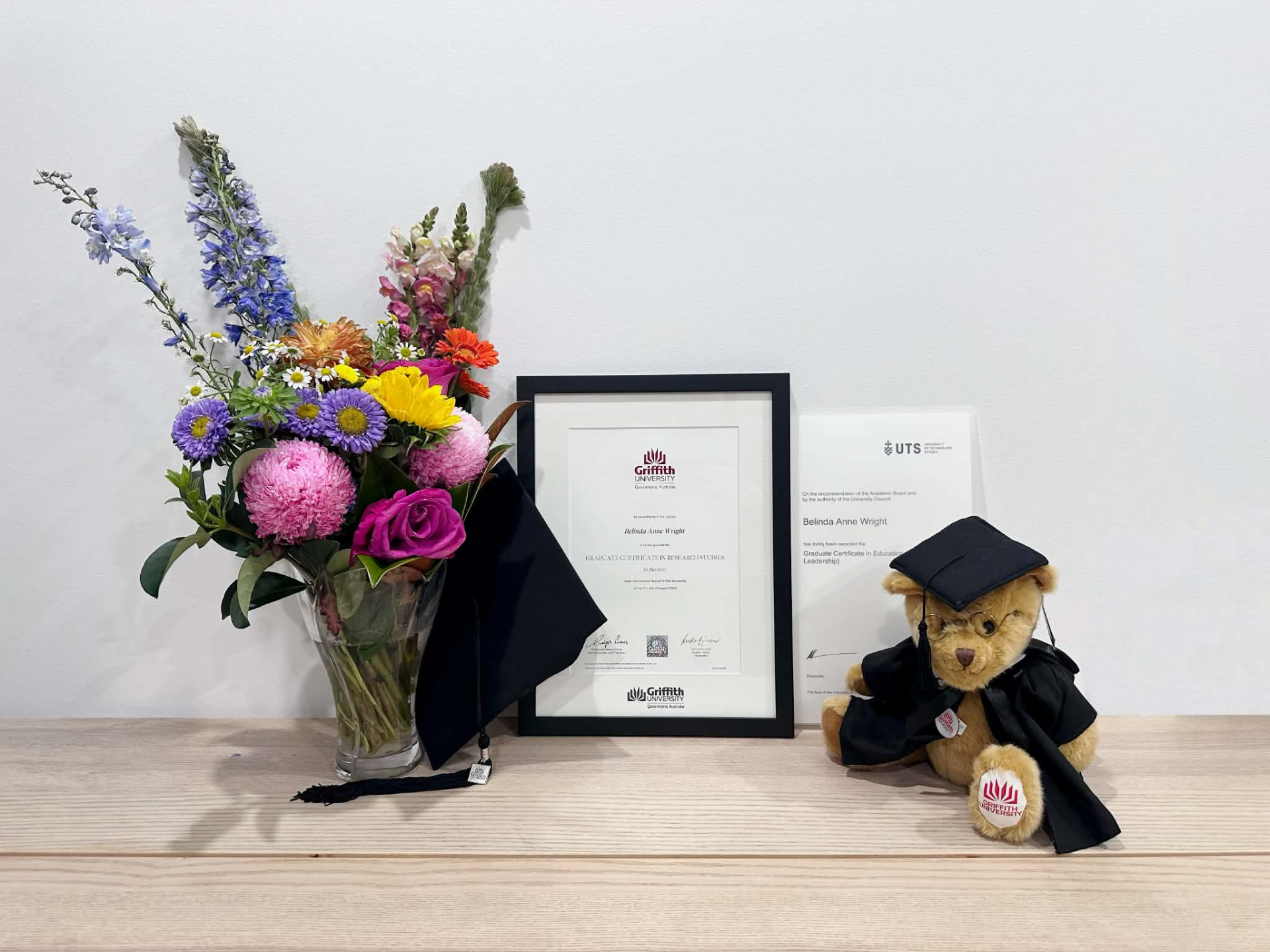
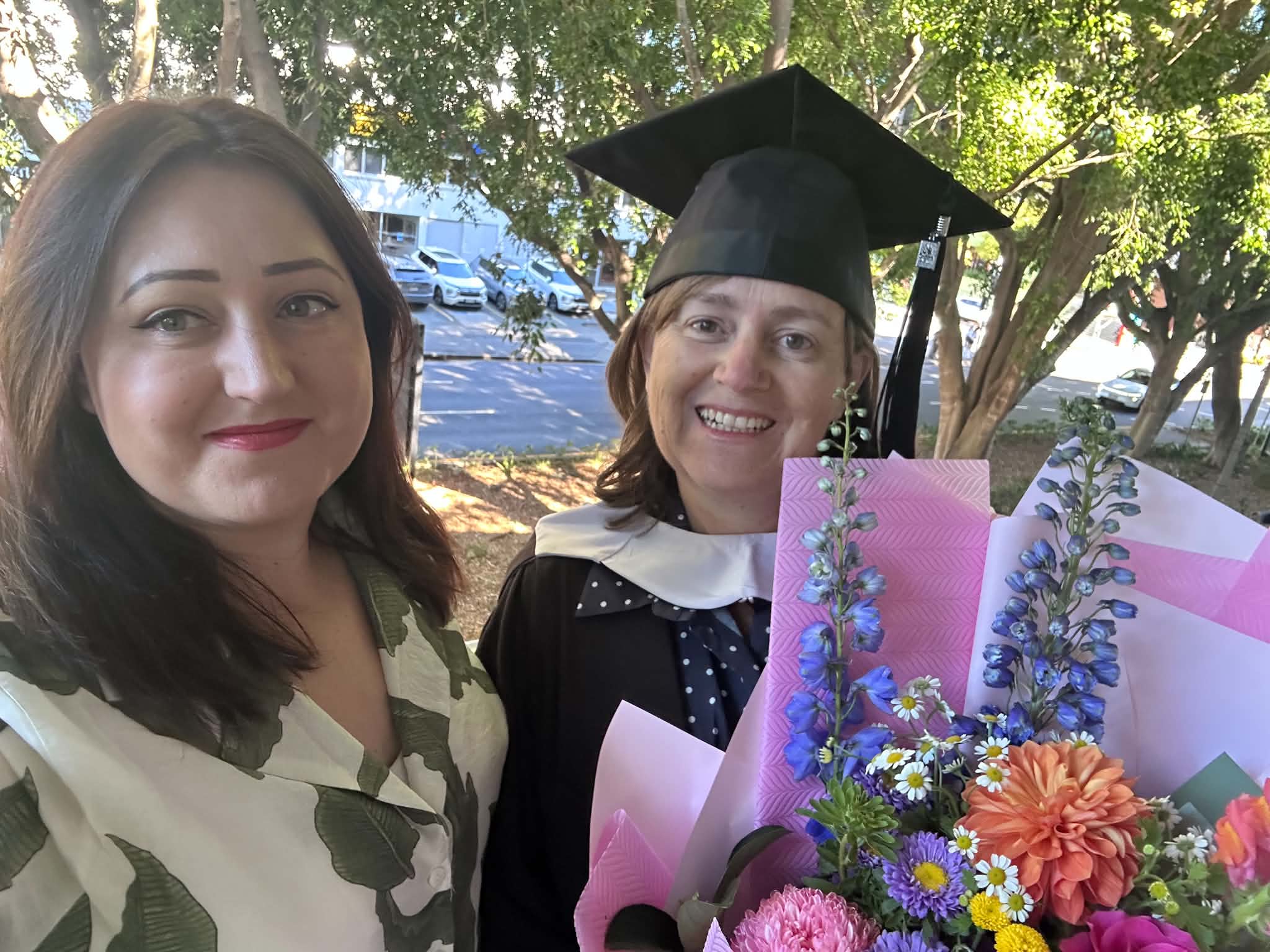
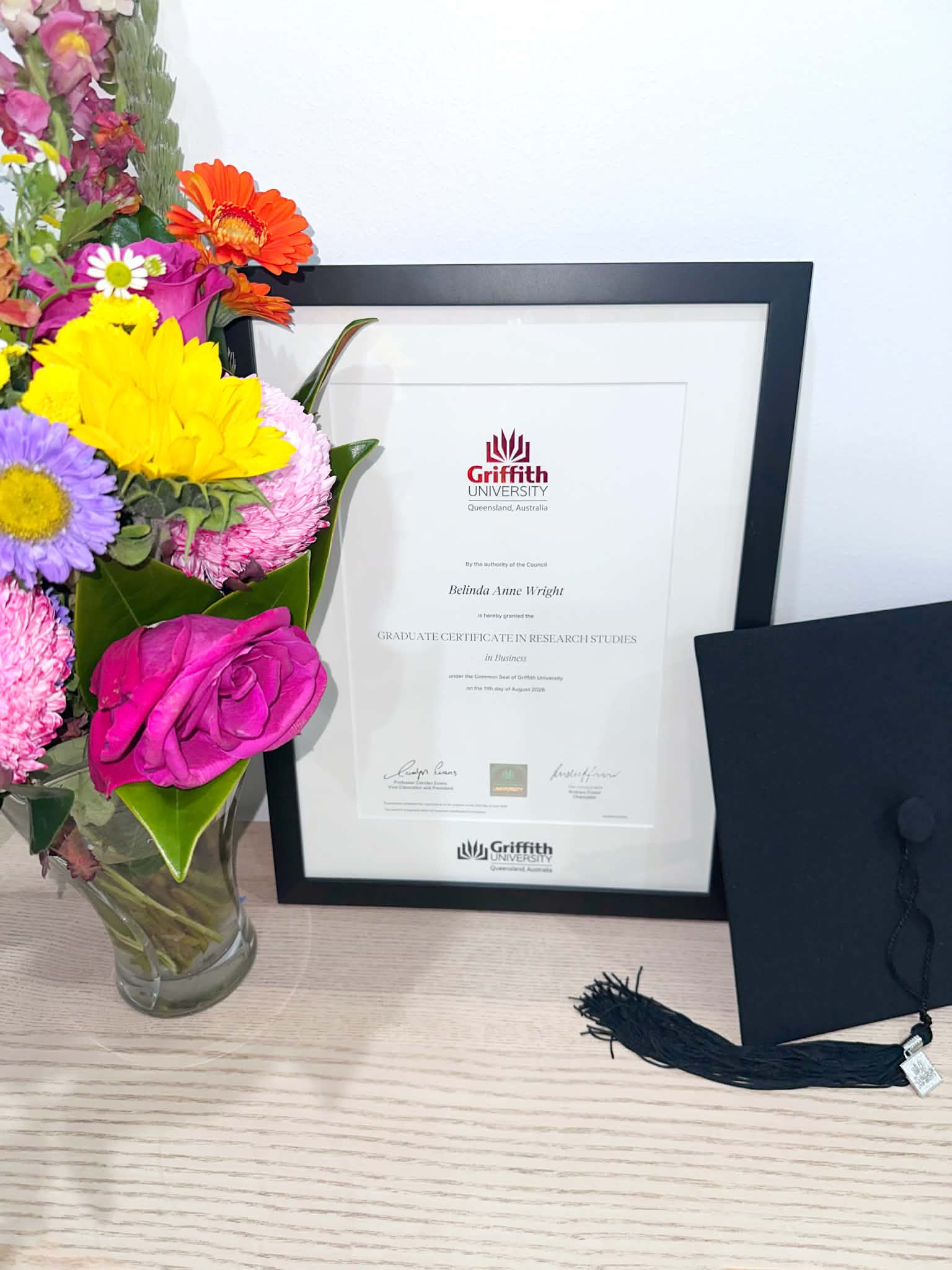
This week, I stood on a stage in Brisbane and graduated with my Graduate Certificate in Research Studies in Business from Griffith University. It was a proud moment, but it also made me reflect on why I have chosen to spend so much of the past few years studying alongside running Learn OSHC, working in the sector and now moving into research.
In December 2025, I also completed a Graduate Certificate in Education – Learning and Leadership at UTS, before continuing into the Master of Education (Learning and Leadership). On paper, these qualifications might look like separate pathways: one focused on learning and leadership, another focused on research. For me, they are very much connected.
They are both part of a bigger question I have been asking for years:
How do we better support the people working in OSHC so that learning actually strengthens practice?
Why I started Learn OSHC
Learn OSHC began because I could see a need for professional development that was designed specifically for the realities of Outside School Hours Care.
OSHC operates within the National Quality Framework, but our context is distinct. We work with school-age children and young people, and our services operate around the school day. Children may arrive tired, energised, hungry, social, overwhelmed or ready to disappear into play with their friends. We work across mixed-age groups, short transitions, long afternoons and busy holiday programs. Educators are constantly making decisions about relationships, play, leisure, agency, inclusion, safety and wellbeing.
Yet professional learning does not always recognise those conditions. I wanted to help educators and leaders interpret the National Quality Framework within the OSHC environment, rather than simply presenting information and expecting people to work out how it applies when they return to their service.
But there was another issue that concerned me just as much. I had seen plenty of professional development where someone attended a session, listened to a presenter, perhaps felt inspired for an hour or two, collected their certificate and then returned to work.
And then…nothing much changed.
Not because the educator did not care, and not because the content was necessarily poor. Often, there was simply no bridge between learning something and using it in practice.
That bridge is where I think much of the real work sits.
Professional development is not the same as professional learning
Learning how to design learning
Completing my Graduate Certificate in Education – Learning and Leadership, and now continuing into the Master of Education, has allowed me to look at professional development from another perspective.
Not simply:
What information do educators need?
But:
How should this learning be designed?
That question opens up a much broader conversation. What should happen before the learning? What should happen during it? How do we help people connect new knowledge with their previous experience? How do we support reflection? How can learning activities mirror the decisions people actually need to make in their workplace?
And perhaps most importantly:
What needs to happen after the formal learning experience ends?
That last question has become increasingly important to me because, if we want professional learning to influence practice, then a course cannot always be the end point. Sometimes it needs to be the beginning of a process.
That process might involve discussion with colleagues, observation, practice, mentoring, reflection, feedback or revisiting an idea after trying it in a real situation. This is particularly important in OSHC, where so much professional knowledge is enacted through judgement. An educator can understand a concept in theory, but applying it while supporting a group of children in a complex social situation is something different.
That is workplace learning.
Not simply:
What information do educators need?
But:
How should this learning be designed?
That question opens up a much broader conversation. What should happen before the learning? What should happen during it? How do we help people connect new knowledge with their previous experience? How do we support reflection? How can learning activities mirror the decisions people actually need to make in their workplace?
And perhaps most importantly:
What needs to happen after the formal learning experience ends?
That last question has become increasingly important to me because, if we want professional learning to influence practice, then a course cannot always be the end point. Sometimes it needs to be the beginning of a process.
That process might involve discussion with colleagues, observation, practice, mentoring, reflection, feedback or revisiting an idea after trying it in a real situation. This is particularly important in OSHC, where so much professional knowledge is enacted through judgement. An educator can understand a concept in theory, but applying it while supporting a group of children in a complex social situation is something different.
That is workplace learning.
Setting educators up to succeed
One of the beliefs that has become increasingly central to my work is that quality is built through people.
Services can have policies, procedures, frameworks, plans and systems, and all of those things matter. But children and young people experience quality through people. They experience it through the educator who notices they are having a difficult afternoon; the educator who knows when to join play and when to step back; the person who creates an environment where a young person feels that they belong; the Educational Leader who helps an educator think differently about a situation; the coordinator who makes time for reflection; and the team who talk about practice instead of simply getting through the afternoon.
Do new educators understand the purpose of OSHC?
Do they understand what quality looks like in school-age care?
Do they understand the National Quality Framework in relation to the work they are doing every afternoon?
Do they understand their role in supporting children's agency, play, leisure, relationships and wellbeing?
From there, there needs to be ongoing professional learning. Not simply when something goes wrong, and not simply because a compliance requirement says training must occur, but because professional capability develops over time.
Services can have policies, procedures, frameworks, plans and systems, and all of those things matter. But children and young people experience quality through people. They experience it through the educator who notices they are having a difficult afternoon; the educator who knows when to join play and when to step back; the person who creates an environment where a young person feels that they belong; the Educational Leader who helps an educator think differently about a situation; the coordinator who makes time for reflection; and the team who talk about practice instead of simply getting through the afternoon.
If we want strong practice, we need to create the conditions in which educators can develop that capability.
For me, this begins long before we send someone to a professional development session. It begins with onboarding and induction.
Do new educators understand the purpose of OSHC?
Do they understand what quality looks like in school-age care?
Do they understand the National Quality Framework in relation to the work they are doing every afternoon?
Do they understand their role in supporting children's agency, play, leisure, relationships and wellbeing?
From there, there needs to be ongoing professional learning. Not simply when something goes wrong, and not simply because a compliance requirement says training must occur, but because professional capability develops over time.
Critically, educators also need people around them who can help them make sense of their practice.
The importance of Educational Leadership
Capability, quality and retention are connected
Why research became the next step

Moving beyond one-off PD